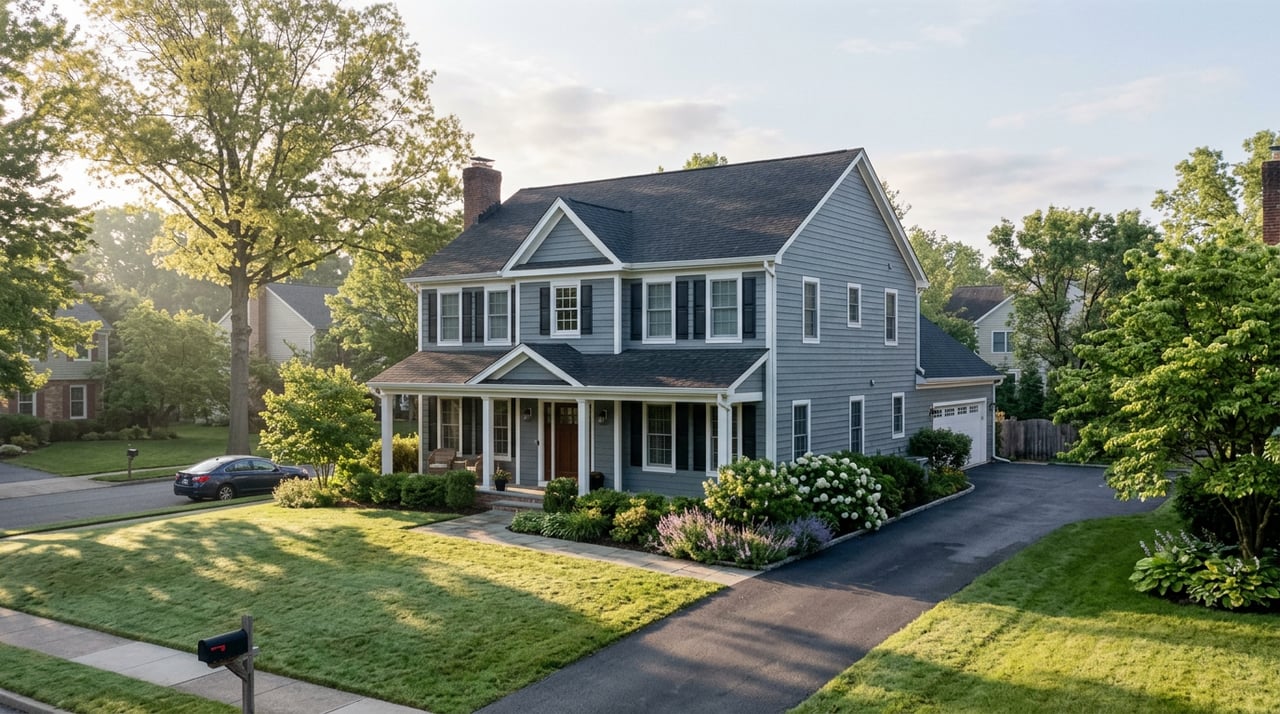
A Chesterfield seller signs the listing paperwork on a Tuesday. The photos go up Friday. An offer comes in the following week at 99% of ask. Then, three days before closing, the buyer's title commitment names the subdivision trust indenture, the buyer's attorney reads it, and someone notices the sunroom addition the previous owner built in 2011 was never signed off by the trustees. The deal doesn't die. It gets renegotiated. Twelve thousand dollars come off the price.
This is the Chesterfield-specific friction that almost no seller sees coming, and it is not an inspection problem. It is a paper problem, and it lives in a document that was recorded with the county before you owned the house.
The mechanism nobody explains until the title commitment lands
Most Chesterfield subdivisions, and nearly every estate neighborhood inside 63005, sit under a trust indenture governed by a board of trustees. In unincorporated St. Louis County and most municipalities, indentures are binding upon every property owner in a defined private subdivision operating under an indenture, and all subsequent or future owners of property in a deed-restricted subdivision are required to abide by the indenture as well. That last clause is the seller's exposure. You inherited the prior owner's violations the day you took title, whether you knew about them or not.
The document itself is not obscure. Indentures are legally-binding, recorded documents recognized by the State of Missouri and recorded with the St. Louis County Recorder of Deeds Office. Any buyer's attorney can pull it. Most do. And because trust indentures are referenced on the title insurance policy, home buyers will become aware of the indentures at closing, the surprise almost always breaks in the worst possible window: after inspection, after appraisal, after both sides have spent money.
The Missouri Association of Realtors' Seller's Disclosure Statement for Residential Property, form DSC-8000, forces the issue up front. The form asks the seller directly whether they are aware of any violation of subdivision restrictions, rules or regulations by yourself or others, and any condition or claim which may cause an increase in assessments or fees. "Others" includes every prior owner. A "no" you cannot defend later is worse than a "yes" you disclose on day one.
Where the friction actually lives
In practice, the violations that surface at Chesterfield closings cluster around a small set of improvements. Each one has a paper trail the trustees can pull, and each one is also flagged inside the City of Chesterfield's approval process, because the city's Municipal Zoning Application requires the owner to sign verifying that subdivision trustees and adjacent property owners have been notified before the permit moves.
| Improvement | Trustee approval typically required | Where it surfaces at sale |
|---|---|---|
| Fence, replacement or new | Yes, plus material and height spec | Title commitment, buyer walk-through |
| Pool or pool house | Yes, plus city MZA | Survey, DSC-8000 disclosure |
| Sunroom or rear addition | Yes, plus Chesterfield UDC §405.02.160 review | Appraiser measurement vs. tax record |
| Driveway extension or second curb cut | Yes, plus city zoning | Survey |
| Detached shed or accessory structure | Yes, size-dependent | Aerial imagery, buyer walk-through |
| Solar array, roof or ground | Yes, and Chesterfield §500.710 | Insurance inspection, DSC-8000 |
| Exterior paint or material change | Often yes | Trustee complaint history |
The pattern the section captures is that improvements move through two parallel approvals in Chesterfield: the private one at the trustee level and the public one at City Hall through the Planner of the Day at [email protected]. The city's own teardown and addition regulation lives at Section 405.02.160 Regulations For Single-Family Residential Teardowns And Additions, and public hearings on that section route notice to property owners within two hundred twenty-five (225) feet of the subject site and all residential subdivision trustees within one (1) square mile of the subject site. If the prior owner skipped one of the two approvals, the improvement is still there, but it is not clean.
Why 2026 makes this worse than 2025
The market itself is what turns a paper defect into a price concession. In May 2026 the median Chesterfield sale price sat at roughly $595,000 with an average of 14 days on market, compared with 8 days a year earlier over the same window, according to Redfin's tracking of MARIS data. Houzeo's March 2026 read put sale-to-list at 99.88% on 1.2 months of supply. Both readings tell the same story from opposite sides: deals still close near ask, but they now sit under contract long enough for a buyer's attorney and title team to read the indenture cover to cover.
In 2025, at eight days on market with waived contingencies common on well-priced homes, indenture defects often closed unnoticed. In 2026, at fourteen days plus a full option period, they do not. That is the interpretive point most sellers miss: the same violation that would have been invisible last summer is now a live negotiation lever for the buyer.
An audit worth doing before the sign goes up
The corrective work is not complicated. It is tedious, and it belongs in the four to six weeks before listing rather than in the five days before closing.
- Pull the recorded indenture and any amendments from the St. Louis County Recorder of Deeds under your subdivision's name. Read the architectural review section and the amendment provision.
- Match every improvement made under your ownership, and every improvement you can identify from the prior owner, against the approval records the trustees hold. Ask the board for a letter of good standing.
- For any improvement you cannot document, submit a retroactive request to the trustees now. The Chesterfield UDC teardown and addition rules at §405.02.160 are the city half of the same problem, and the Planner of the Day can confirm whether a matching MZA exists.
- Answer the DSC-8000 subdivision section honestly. If a violation exists and is being cured, note that. A disclosed and remediated item almost never re-trades. An undisclosed one almost always does.
- Order a pre-listing survey if any improvement sits near a lot line, easement, or common ground boundary. It is cheaper than the credit a buyer will demand for the same information at day thirty.
Sellers who do this in April close in June without a re-trade. Sellers who skip it hand the buyer's attorney a free tool.
The Valley overlay in 63005
For homes inside or adjacent to Chesterfield Valley, there is a second document a buyer's team will read: the Monarch-Chesterfield Levee District's assessment history. During the Great Flood of 1993, the existing levee failed causing flood damages in excess of $200,000,000, and the current assessed value of the valley is $1.8 billion. The district has previously petitioned the Circuit Court of St. Louis County for readjustment of assessment of benefits under Cause No. 18SL-CC01793, which is public record through Missouri Lawyers Media.
The district also continues to spend. At its September 2 meeting, the City Council approved the memorandum of understanding with the Monarch-Chesterfield Levee District to complete phase 6 of the levee trail, with a base bid for construction of $903,800, which includes change orders that arise during construction, and another $50,000 for asphalt trail restoration, and the levee district has hired Kuesel Excavating to complete the improvements. For a Valley seller, the practical point is that any question a buyer's attorney raises about future assessment posture is answerable with real numbers and a real project schedule, not hand-waving.
FAQ
Do trustees have to approve the sale itself? No. Trustees govern the property, not the transaction. What they can do is respond to a title company or buyer's attorney inquiry with a violation letter, and that letter is what shows up at closing. Getting a good-standing letter in hand before listing is the move.
What if the indenture has not been amended since the 1980s? It is still enforceable. Most indentures are drafted with perpetual lifespans and have clear provisions for renewal. Old does not mean dormant. Read the amendment provision to understand what it would take to modernize it, but assume every current restriction is live.
If a violation existed when I bought, is it still my problem to sell? Yes. The city's own guidance treats indenture enforcement as civil between the association and the owner, meaning government authorities do not enforce subdivision trust indentures; indentures are private, contractual agreements between a subdivision association and an individual property owner. That structure is exactly why title commitments call them out, and exactly why buyers price them into an offer once they see them.
Does this apply to condo or villa properties? The mechanics are similar. The DSC-8000 asks about both subdivision and condo restrictions in the same section, and Chesterfield's teardown and addition rules apply across single-family categories under the UDC.
The through-line here is simple. In a 2025 market, indenture defects hid. In a 2026 market, they negotiate. The sellers who net the top of their range in Chesterfield this year are the ones who close the paper gap before the photographer shows up, not the ones who discover it three days before closing.
If you are thinking about listing a Chesterfield home this season and want a walkthrough of the indenture, permit, and disclosure work before the sign goes up, the Jeff Lottmann Group is glad to schedule a market consultation.