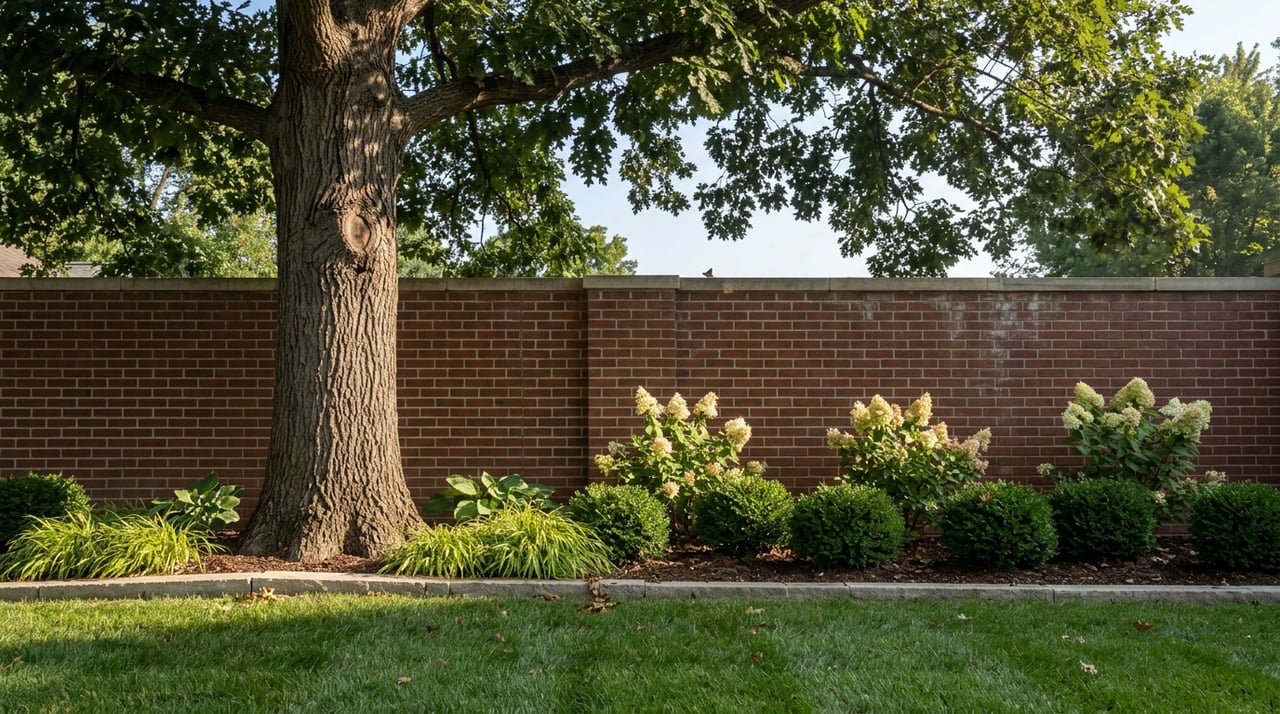
Two one-acre lots list within a few weeks of each other on opposite sides of Town and Country. Same asking price. Same trailing comps. One buyer closes, tears down, and breaks ground by summer. The other closes, hires an architect, and is still waiting on approvals nine months later while a bond sits with the city. The deeds say the lots are identical. The buildable acres are not.
That gap is the single most misread number in this market, and it is the reason comping Town and Country purely on price per acre or price per square foot produces answers the transaction will not honor. As of the current Zillow Home Value Index, the typical home here sits around $1.18 million, up roughly 6% year over year, and homes.com's trailing-twelve-month median runs closer to $1.13 million, up about 16%. Both are true. Neither tells you what a specific acre will let you build.
The rule that reprices your acre
The mechanism sits in Section 405.336 of the municipal code, the city's Residential Tree Protection and Removal Standards. A "Grand Tree" is any tree twenty inches DBH or larger in fair-to-good condition. Grand Trees cannot be disturbed within their Critical Root Zone during grading, demolition, or new construction unless a Tree Protection Plan specifically authorizes it. Every plan of consequence has to submit a tree chart listing size, cross-sectional area, species, and condition of every tree on site, sealed by a Missouri-licensed landscape architect or ISA-certified arborist.
Two numbers inside that ordinance quietly set the ceiling on what a wooded lot will site. First, the Critical Root Zone radius equals 1.25 feet for every one inch of trunk diameter. A thirty-inch oak carries a 37.5-foot protected radius, a circle nearly 4,400 square feet before you have laid the first footing. Second, no more than 25% of any Tree Protection Zone may be impacted. Multiply either constraint by a lot with three or four Grand Trees and the buildable envelope on a "one-acre lot" can shrink to a fraction of what a portal photograph suggests.
The escrow and ARB layer
Buyers reading MLS remarks see "wooded" as an amenity. The rebuild math treats it as a line item. Before any permit issues on a site with preserved woodland, the developer posts a surety bond in the amount of $25,000 per acre of woodlands preserved, and a separate tree restoration escrow deposit based on the appraised dollar value of every tree on the protection list. Utilities that must cross a protection zone have to be directional bored. Open trenches through a TPZ are not allowed.
The Architectural Review Board sits on top of that. All new residences, additions over 500 square feet, subdivision gates, and roof-facing solar require ARB approval before permitting, with meetings on the first Monday of each month. The ARB submission page currently shows new-house packages at 13309 Buckland Hall and 12334 Wildlife Trail moving through the queue. The mechanics are specific:
- $350 ARB application fee, two staff-review packets, twelve collated packets ten days before the hearing
- $200 demolition application, plus a $5,000 cash escrow for street guarantees
- Thirty days to complete demolition once the permit issues
- Pre-demolition city site inspection to confirm BMP/siltation fencing and tree protection fencing are installed
- Building codes moving from the 2018 to the 2024 International Building, Residential, and Mechanical Codes
None of that shows up on a listing sheet. All of it shows up on the schedule and budget of a rebuild.
The state-law tail you inherit at closing
There is a further wrinkle that a buyer of a wooded T&C lot inherits the moment title transfers. Under RSMo 537.340, Missouri imposes triple damages for unauthorized cutting, injuring, or destroying of a tree on another owner's land, on a strict-liability basis. A contractor who clears past a stake, a neighbor who trims across the line, an excavator who nicks a Grand Tree's root plate during utility work, any of it lands in triple-damages territory before the question of intent is even reached. On a rebuild lot with mature canopy on two sides, that risk sits on the new owner's side of the closing table.
Why the teardown pattern is the tell
Look at what is actually being built. Slavin Homes has an ARB-approved 6,000-plus-square-foot custom cleared to begin construction on a private one-plus-acre lot. McBride Homes is delivering the Willow floorplan at Woods Mill Crossing near Highway 141 and I-64. Fischer Homes has the Grayson, Huxley, and Teagan plans at Deer Hollow in 63141. What you do not see is subdivision-scale greenfield development. Town and Country's minimum lot size has stayed at one acre since 1950 incorporation, and the city occupies roughly fifteen square miles with no meaningful annexation runway.
That mix creates a specific incentive structure. Every net-new luxury house at the upper end of the market has to come from either a teardown or one of the very small number of remaining infill parcels. The custom builders who work here are not selling floor plans, they are selling a completed run at Section 405.336, an ARB packet that clears on the first submittal, and a demolition-to-slab schedule that respects the thirty-day window. That expertise is priced into the build cost. It is also priced into the small subset of lots where a builder has already done the pre-work.
What this means when you are comparing lots
The practical read is that two Town and Country listings at the same asking price can produce very different post-close outcomes depending on tree inventory, siting flexibility, and where the property sits in the city's micro-geography. The Kehrs Mill Road corridor near the Chesterfield line trends toward homes built between the late 1990s and the 2010s on somewhat smaller and more open lots. The properties along the eastern edge near Ladue trend older and more established, often on parcels with mature canopy and, in a handful of cases, structures with farmstead-era roots. Same city, same schools, same zoning envelope on paper, materially different rebuild economics.
A rough working comparison for buyers who plan to rebuild or heavily renovate:
| Lot archetype | Typical build era | Canopy profile | Rebuild friction to price in |
|---|---|---|---|
| Kehrs Mill transition (west) | Late 1990s to 2010s | Younger trees, open pads | Standard ARB cycle, lower TPZ impact |
| Central estate acre | 1960s to 1990s | Multiple Grand Trees | CRZ-driven footprint, higher escrow exposure |
| Eastern established (near Ladue) | Original to mid-century, some 2000s rebuilds | Mature, often protected woodland | Woodland surety bond, arborist plan, longer schedule |
The point is not that one archetype is better. It is that the same $1.4 million buys three different projects, and the difference is set by the ordinance rather than the deed.
How this changes the offer
For a buyer who intends to keep the existing house largely as is, most of this is background. For a buyer whose thesis depends on rebuilding or on a significant addition over 500 square feet, three questions should be answered before the inspection period closes:
- What is on the lot's tree chart today, and how many trees cross the twenty-inch Grand Tree threshold
- Where does the desired building envelope sit relative to the Critical Root Zones of those trees
- What has the ARB approved recently on comparable lots, and what did the packet look like
None of those answers are on a listing sheet. All of them are answerable inside a standard due-diligence window if the right people are looped in early. That is the work that separates a Town and Country lot purchase from a suburban lot purchase almost anywhere else in West County.
A short FAQ
Does the tree ordinance apply to a straight remodel inside the existing footprint? Section 405.336 is triggered by permits related to site development, demolition, and new construction. Interior remodels that do not disturb site grading or the critical root zones of preserved trees do not sit in the same regulatory path, though additions over 500 square feet still route through the Architectural Review Board.
How long does the ARB cycle add to a project? The board meets on the first Monday of each month, with packets due at least ten days ahead and staff comments issued in advance. A clean single-pass approval adds weeks. A revision cycle can add months. Builders who work here regularly assume at least one full meeting cycle in their schedule.
Is the $25,000-per-acre woodland bond refundable? The surety bond is posted for the benefit of the city and is tied to compliance with the approved Tree Protection Plan. It is a performance instrument, not a fee, but it is real capital tied up for the duration of the project and needs to be modeled into the rebuild pro forma.
Does any of this affect resale value on the finished home? The same ordinance that constrains construction also protects the mature canopy that drives long-term value stability in the city. Lot size, tree coverage, and creek frontage move price on similarly-sized homes here, which is why the rebuilds that respect the site tend to hold value better than the ones that fight it.
Town and Country rewards buyers who understand that the deed and the buildable acre are two different things. If you are working through a purchase where a rebuild or a substantial addition is on the table, the team at Jeff Lottmann can walk the ordinance math with you before you sign, not after. Schedule a market consultation and we will map the lot, the tree chart, and the ARB path against what you actually want to build.